HOUSE OF TRUTH Ivri Books
House of Truth in the New Covenant Publishing

The Seventy and the One

Babel's Gods, the Nations' Altars, and the Grafting of All Peoples into Yisra'el through Yeshua

Malkiy'el Yashar Tsadiq 364 pages 125,000 words 43 chapters in 7 parts 2026

Seventy received the nations. One asked for them back.

Read in the app Yours for life. One device at a time, moved whenever you need.
KES 1,299
Paperback Paperback · trim size to be confirmed. Delivery KES 350. Pre-order.
KES 3,500
The book

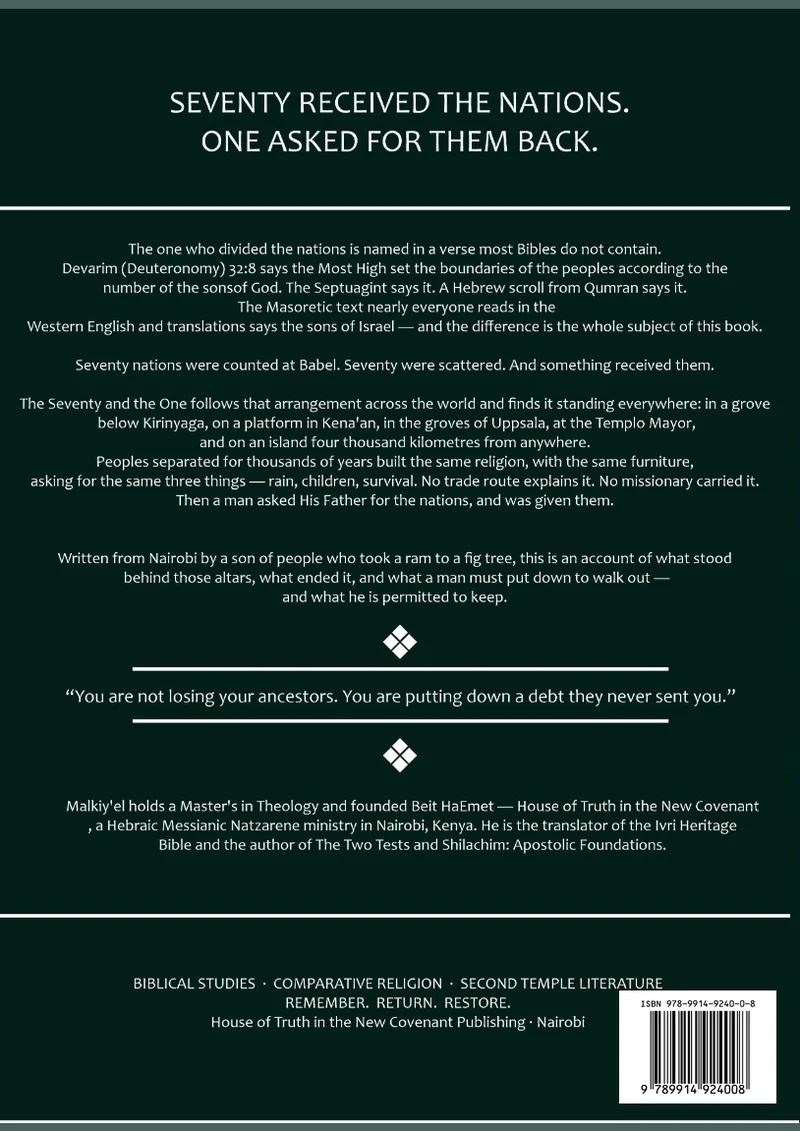
The one who divided the nations is named in a verse most Bibles do not contain. Devarim 32:8 says the Most High set the boundaries of the peoples according to the number of the sons of God. The Septuagint says it. A Hebrew scroll from Qumran says it. The Masoretic text that nearly everyone reads in Western English says the sons of Israel, and the difference is the whole subject of this book.

Seventy nations were counted at Babel. Seventy were scattered. And something received them. The Seventy and the One follows that arrangement across the world and finds it standing everywhere: in a grove below Kirinyaga, on a platform in Kena'an, in the groves of Uppsala, at the Templo Mayor, and on an island four thousand kilometres from anywhere. Peoples separated for thousands of years built the same religion, with the same furniture, asking for the same three things: rain, children, survival. No trade route explains it. No missionary carried it.

Then a man asked His Father for the nations, and was given them.

Written from Nairobi by a son of people who took a ram to a fig tree, this is an account of what stood behind those altars, what ended it, and what a man must put down to walk out, and what he is permitted to keep.
Why this book
01

A thesis that can be checked

The whole argument turns on one verse, and Appendix B is a full dossier on it: Devarim 32:8 and 32:43 across the Septuagint, the Masoretic text, 4QDeut-j and 4QDeut-q. Appendix C does the same for Amos 9:12. A reviewer is handed the evidence rather than the conclusion.

02

A global survey, not a regional one

Eleven chapters walk the same pattern through twelve regions of the earth, including chapters most books of this kind do not attempt: Rome's second allotment, the Middle Passage religions, and the allotment in the modern West.

03

Written from Africa, about everywhere

Chapter 19 treats the nations of Kenya by name and at length. This is a book that takes African religion as seriously as it takes Greek and Norse religion, and subjects all three to the same test.

04

It does not stop at diagnosis

Parts Five and Six give the practical exit: renunciation liturgies, a household liturgy for entering the mo'edim, the ancestor question addressed directly, and the Four Cuts. Usable by a congregation, not only readable by a scholar.

05

A book that ends in a song

The argument closes in a scored anthem, printed with its full arrangement and recorded. Few books of this kind give a congregation something to sing at the end of them.

06

A companion, not an orphan

It stands beside The Ivri Heritage Bible and six further volumes, and cites Scripture from that rendering throughout.

For readers ofMichael Heiser, Margaret Barker, John Walton and Tim Mackie; and of Mbiti, p'Bitek and Idowu on African traditional religion.

Contents · 43 chapters in 7 parts
I

The Allotment

7
  1. 1 The Table of Seventy
  2. 2 The Tower and the Scattering
  3. 3 The Verse That Was Changed
  4. 4 Given Over to the Host of Heaven
  5. 5 The Council That Failed
  6. 6 Princes Over Territories
  7. 7 Boundaries and Appointed Times
II

The Shape of an Allotted Religion

7
  1. 1 The Withdrawn Creator
  2. 2 Rain, Womb and Shield
  3. 3 Sacred Geography
  4. 4 The Mediator
  5. 5 The Dead as Gods
  6. 6 Blood, Oath and Land
  7. 7 No Book, No Mashiach, No Mission
III

The Allotment Surveyed

11
  1. 1 Kena'an
  2. 2 The Nations of Kenya
  3. 3 Africa Beyond
  4. 4 Mesopotamia
  5. 5 Greece and Rome
  6. 6 Northern and Eastern Europe
  7. 7 Asia
  8. 8 The Americas and the Pacific
  9. 9 The Middle Passage Religions
  10. 10 Rome's Second Allotment
  11. 11 The Modern West
IV

The Reversal

7
  1. 1 Ask of Me the Nations
  2. 2 The Seventy Sent Against the Seventy
  3. 3 Shavuot: Babel Undone
  4. 4 Disarming the Rulers
  5. 5 The Fallen Sukkah of David
  6. 6 The Grafting
  7. 7 Rut the Mo'avitess
V

Coming Out

6
  1. 1 Come Out of Her, My People
  2. 2 The Four Cuts
  3. 3 Renouncing by Name
  4. 4 The Calendar Exit
  5. 5 The Ancestor Question
  6. 6 Household, Clan and Identity
VI

Prayers, Liturgies and Declarations

6
  1. 1 Renunciation of Ancestral Gods
  2. 2 A Kenyan Tribal Renunciation
  3. 3 Breaking Colonial and Slave-Trade Trauma
  4. 4 A Household Liturgy for the Mo'edim
  5. 5 The Declaration of Grafting
  6. 6 The Four Cuts
VII

Appendices

8
  1. 1 The Ha'azinu Dossier — Devarim 32:8 and 32:43
  2. 2 The Amos 9:12 Dossier
  3. 3 Glossary
  4. 4 Scripture Index by Theme
  5. 5 The Seventy Nations of Bereshit 10
  6. 6 The Universal Pattern Across Twelve Regions
  7. 7 Ethics of Engagement
  8. 8 Bibliography and Index
The theme song · The Reversal (Grafted In)

The book ends in a song, printed in full at page 364 with its arrangement marked through: an opening oud over distant floor toms while Devarim 32:8 is spoken, three verses on a marching rhythm, a long cinematic break in which the minor chords resolve into the major, and a final chorus at full voice. The refrain is the book's thesis in four lines. A studio recording exists, six minutes and twenty-four seconds, sung in English with a Hebraic accent.

A studio recording exists. Six minutes twenty-four seconds, sung in English with a Hebraic accent. An original composition, separately registered as a copyright work in Kenya. All rights reserved. Performance, synchronisation and licensing enquiries to the House.
The author, and the back cover

Malkiy'el Yashar Tsadiq is the founder and principal of Beit HaEmet Brit Chadashah — House of Truth in the New Covenant Publishing — in Nairobi, and leads a Hebraic Messianic Natzarene assembly. He holds a Bachelor and Master of Theology and a Diploma from Central Bible College, with ministerial certifications and ordination through Christ Dominion Church Kenya. He is the editor and translator of The Ivri Heritage Bible, a Septuagint-primary rendering of a hundred and seventeen books in four Seasons, and the author of The Two Tests and Shilachim. Of Kikuyu heritage, he is a grandson of Kung'u Karumba of the Kapenguria Six.

The foreword is by Samilla Antoinette Ndungu, the author's wife of more than twenty years, who writes from inside the household the book describes.
Back cover of The Seventy and the One
The back cover
Details
ISBN
978-9914-9240-0-8
PUBLISHER
House of Truth in the New Covenant Publishing
FORMAT
Paperback · trim size to be confirmed
EXTENT
364 pages · approx. 125,000 words
PUBLICATION
2026 · printed in Nairobi, Kenya
CATEGORIES
Biblical Criticism & Interpretation · Old Testament · Messianic Judaism · Antiquities & Archaeology · Anthropology · History of Africa
RIGHTS
World. All rights reserved. The song is registered separately.
ENQUIRIES
beithaemetbritchadashah@gmail.com · +254 792 819 867
About the digital edition. It is read here on this site — there is no file to download, so nothing can be forwarded on. Your copy stays on one device at a time, and you can move it to another yourself, free and without limit, whenever you need to. Every page carries your name. This House is small and this book took years; copies passed around are copies not bought.
From the back cover
“You are not losing your ancestors. You are putting down a debt they never sent you.”
Choose an edition · from KES 1,299